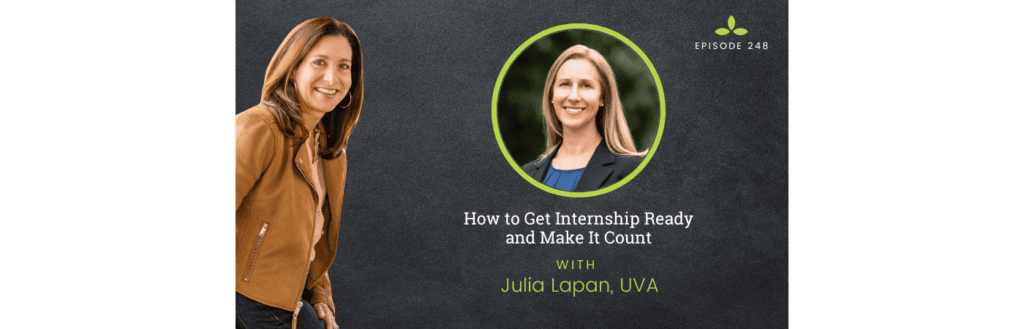
#237 How to Tell If a College Will Prepare Students for Career Success with Julia Lapan, UVA Transcript

Flourish Coaching
Jul 28, 2026
THIS IS AN AUTOMATED TRANSCRIPT… PLEASE FORGIVE THE TYPOS & GRAMMAR! xo-Lisa.
Lisa Marker-Robbins 00:58
Whether your student is building a college list, getting ready to head off to campus, or already enrolled? There’s one question every single one of you should be asking: Is this college preparing them not just to earn a degree, but to build a successful career after graduation? See, most families focus on rankings, majors, campus tours, and costs; those things absolutely matter. So don’t get me wrong, but I don’t believe they tell the whole story. My guest today is Dr. Julia Lapan, Executive Director of Career Design and Discovery in the College and Graduate School of Arts and Sciences at the University of Virginia. Throughout her career, she’s helped reshape how one of the nation’s top universities prepares students for life after graduation. Just the thing that we focus on here. So instead of waiting for students to find their way over to career services, UVA is now intentionally weaving career exploration, reflection, networking, and real-world experiences throughout the journey. What they are doing can positively influence how your family approaches college. So stick with me here in our conversation. Julia is going to explain why the traditional career center model it just isn’t enough on its own. What helps students build confidence in meaningful professional connections and why these experiences matter long before graduation. She also shares a new way to think about what students need from a college and what families should look for when evaluating any college experience. So whether your student is choosing a college, preparing to start their first semester, or already have their feet on campus, this conversation will help you think differently about what really prepares young people for success after graduation. You’ll discover a new way to evaluate colleges and better understand how students can intentionally use their college years to build confidence, connections, and career directions. I’m Lisa Marker Robbins, and I want to welcome you to College and Career Clarity, a flourish coaching production. Let’s dive right into another great conversation. Dr. Julia LePen, welcome to the show. It’s so good to have you. Thank you so much. I’m so thrilled to be here. Well, as as I was preparing and I was looking at like the work that you’ve been doing and the work that we do, I’m like, ah, these are the type of conversations that not only like are life giving to me with the work that I’m doing supporting young people, but it’s really what our listeners want to hear, right? They want to be so intentional, and you know we’re serving 15 to 20-five. You’re in the thick of it with these college kiddos, and I think that we’re going to bridge all the the stages. And we’re both parents too, so this is exciting to me. So tell us a little bit at UVA. You’re in in with arts and sciences. You got that humanities going. I think you guys have like what 55 majors or so that I see.
Julia Lapan 04:09
Absolutely.
Lisa Marker-Robbins 04:11
So you guys are you have this new career design program, but you are not new to career design. And so why did UVA? Why would any college need a program around career design like this?
Julia Lapan 04:25
Yes, yes. Thank you so much. So, my background: I have more than 20 years of experience supporting college students in career development, and the majority of that time I’ve spent in very traditional career services roles across multiple institutions. So I’ve worked at private four-year colleges. I’ve worked at at University of Virginia, a public institution, and what I really think I think we’re in this moment in higher education today. Where we are beginning to realize, if if we say it is our mission to prepare students for what’s next, then career development, career readiness, career education needs to be central to the student experience. And what I’ve found, you know, over my many years supporting students in traditional career services roles is that even the best career center, really at most, can only see about a third of its students, and that leaves a huge swath of students out of the mix. And what we’re doing here at UVA in our College of Arts and Sciences in our career design and discovery effort is really integrating this idea of career readiness, career support, career design, and discovery into the undergraduate experience. And I’m I’m thrilled to be leading this charge.
Lisa Marker-Robbins 06:03
I love it. It is. It’s interesting to me. You probably are familiar with Jeff Salingo and everything he’s written, and he’s very well researched. I had him on the podcast back in January of this year on episode 212 and what we did with his dream school book is we just extracted everything that was like career oriented across those chapters, and here’s what surfaced, and it it’s it’s really like what you just said. If we’re preparing these kids well, parents what they want, what they think they’re purchasing when they make a consumer decision, is a career outcome that is the number one outcome that they expect a career outcome as an ROI. So I love that you’re recognizing, like, okay, this is our mission, right? It’s a lot of things we’ve got a lot of things we want to accomplish, but to prepare them to, I always say, get out of our own homes, stand on their own two feet, be happy, be thriving, be financially independent. So we as parents are not their emotional financial backstop. You can’t. I mean, yeah, they have to have executive functioning skills and financial literacy skills. You have to have a job. You have to have a job, so important. So tell me from like when you started doing, which you said traditional career services work, to where you are now. What is the biggest differentiator between like a parent who’s listening who might go like, yeah, I didn’t even go to career services when I was in college, or I or I was maybe the third that used them? How have things evolved? Like, because a parent’s just thinking this is what I find all the time. Parents think about what their experience was, and they have a really hard time extrapolating up to where we are now and how it’s different.
Julia Lapan 07:55
Absolutely. So, first of all, I think that many many people are still rooted in this placement paradigm. By the way, I’ve strongly disliked that word placement for a number of reasons, and really, that that’s a paradigm that was prevalent, you know, 3040, or more years ago, in around the 1990 s. You know, so so higher education in the you know mid 20th century was all about this individualized career support. The proliferation of career advisors or career counselors were coming on the scene, and then those evolved into career centers where the primary function was career advising, and so with a traditional career center, it relies on students opting in, students deciding they’re ready to have a career conversation, taking the initiative to figure out where to go, who to see, and then having the courage to an initiative to take that step, and for many college students, they either don’t feel ready, or they’re even unaware that those services exist because those services tend to be marginalized and outside the mainstream of their academic and student experience, whereas now shifting to this, what many of us are calling the eco career ecosystem model, it does not rely on a student opting in. It doesn’t rely on a student feeling ready. It this is something that every student can and should experience from the moment they set foot on campus. So it and and to me, yes, career outcomes are important. But what we’re doing, at least what we’re doing here at UVA, is we’re not. We don’t see ourselves as preparing students for a job or preparing students for a career, even. We are helping students understand fundamentally who they are, who they’re becoming, and who they want to be in the world. And in and in what ways do they want to impact the world? How do they want to live in the world? And to really bring their full self into that mix. So it’s it’s really about helping students align their curiosities, their values, what’s important to them, and and helping them integrate that into a design that that really fits them, and also importantly fills a need in the world.
Lisa Marker-Robbins 10:43
Love it. We always, with the work that we’re doing with our launch career clarity, I say we start with self awareness, and I define exactly what you just did. It is understanding what motivates me. It’s understanding what my strengths are, what I expect and need from my work environment, my coworkers, what values I have, and not only strengths but limitations too, right? Like getting real because we can’t just-I could not be a brain surgeon or a NASA rocket scientist. My brain is not wired that way, right? And so I’ve got some limitations around math and science, and that’s okay, right? I’ve got lots of strength. So, when we’ve got that deep self awareness, that’s there was actually a study years ago that was the most successful CEOs among like I think it was based around Fortune 100 CEOs. It wasn’t socio economic background. It wasn’t where they went to school, UVA is an amazing school. wasn’t UVA versus the local community college; it was they had deep self awareness, and they everything they did was rooted in that self awareness. Huge,
Julia Lapan 11:54
100 100% I love that
Lisa Marker-Robbins 11:57
you guys. So, so really, basically, you said ecosystem, but this is embedded in the student experience. So there’s not any like I’m ready. I’m going to march on over to the career services building.
Julia Lapan 12:12
We we have a great career center, and I and I and I I I would be remiss if I didn’t say that there’s still this this is still an important function within an institution. Yes, absolutely. I mean, they’re the ones that are going to help the students build their resumes, you know, connect to employers. Yeah, you know, they run career fairs. They they they bring so much value add. But I think the important thing to know is that alone is not. You know, no career center alone can do this work. Everyone at an institution is responsible for student success, in my view. And so, what the ecosystem looks like, and what we’re building here at UVA, is integrating into our first year experience, into our Gen Ed requirements. We are, you know one of the things that I found college students need, but but colleges rarely do, is carve out time and space for students to reflect on these these these things. Yeah, who am I? Who am I becoming? How do I want to impact the world? And so we are building in that time and space into the curriculum for students to reflect on their curiosities and their values. We are we’re setting students up to make connections with people in the world who can answer their questions. No career advisor, you know this, Lisa, from the work you do. You know you are may not know. I think you had an example about around food industry, yeah, you know, you might be you you are able to advise that person on the process, right? And you know that’s what our faculty and our advisors can help students do. They can help students explore by asking questions like, you know, who can you talk to about that, or you know why is that an interest of yours? Because I find there you know there are often two types of students when they get to college. They are either the ones that are I know what I’m going to do. I have a path and a plan, and there are lots of reasons why they should consider multiple alternatives. And then there are the students that come in and say, “I don’t know. I have no idea. There, you know, the world is my oyster. I’ve been told I can do anything, but now I feel paralyzed by this, you know, in the indecision. And so I think our job as whether we’re faculty, staff, advisors, is to meet the students where they are, help them take the that not help them develop a 30 year plan or even a five or 10 year plan. That
Lisa Marker-Robbins 14:47
first step into the real world. That’s that one
Julia Lapan 14:49
step, one step forward toward answering those questions. And I think even before that, we have to have we have to help students. Ask good questions.
Lisa Marker-Robbins 15:01
Yeah, well, we every week in my newsletter I do a conversation queue, and it’s meant to support families in having these conversations. Because to your point, you know we live in an Instacart society, right? I can pick up my phone right now and order my groceries or my dinner, and I don’t, and I think it’s crazy the amount of money my own children spend having food delivered to their house. But we can have everything at our doorstep within like an hour or two, right? I could have Kroger on my doorstep in the next couple hours, and so this idea of like slowing down and reflecting has to be built in. We have to have this time, and I know from being, you know, master certified in the Berkman, some people are wired to move quickly and be decisive and push to results. Others are wired to, and this relates to their career choices, of course, as well. But part of their wiring is to be highly reflective. Over reflect could lead us to analysis paralysis, and moving too quickly. To your point, we don’t gain the insights, right? And so I love the idea of building into the curriculum that time to do it. I also love what you said, and I think this is a huge takeaway for parents, particularly, you did a great job of saying like career services has not gone away at UVA, right? They’re going to help you with your resume. So this delineation around what you’re doing in arts and sciences to facilitate career design and discovery versus there’s still a place to have a good resume, to have a great LinkedIn profile, to meet alumni is key. So they both are needed, but this has always been there by an opt-in, right? But we’ve got to like start building into the, as you said, ecosystem. So it’s interesting on these kids who arrive on campus that think they want they know what they want to do. Do they usually? Because we work a lot with like validating your path, even if you think you might know what you want to do. A lot of times, these kids are told, “Oh, you’re really great at this subject in school, so this naturally aligns with this. Go ahead and and do this career, and they think, oh, that sounds great. I have found when you skip steps, you skip results. And so, how do you talk to the family, the kid who lands on UVA’s campus, or what advice would you have to a family with a high schooler of like, if you think you have a direction, how do you guys layer in? Like, don’t dismiss all the things because a lot of times they do. They go, “Oh, I, I got it. I think I know what I want to do.
Julia Lapan 17:50
Right, right. And that’s and and having a direction isn’t a bad thing in itself. Right. And I I love the way you position it in terms of validating. That is so important. And I see, you know, I talk with students and families about three main ways that students can validate and test. One is through conversations, and that’s a big one because, especially for this generation, because they they struggle having those those one-on-one conversations, so you know helping them, connecting them with some safe people first to have these conversations. So you know, I mentioned you know when I was in engineering at UVA in my previous role, and we integrated a career design framework into the first year curriculum. One of the things we did was we we assigned students to do an informational interview with an alum or another professional. Couldn’t be a family member.
Lisa Marker-Robbins 18:50
I always say the same thing. It’s too safe,
Julia Lapan 18:54
too safe. So someone you have not met and that you don’t know, and the students told me afterwards this was the most impactful assignment of all of the assignments we gave them in their first year, and they said it was intimidating at first, but once they did it, and they realized, oh, this is not that big of a deal. Yeah, you know what I tell them is now go out and do that many many times over. So you know, I tell I tell students and parents validating through conversation. Number one, validating through small experiments or experiences. So you know, a lot of people think about an internship. I think, is a great way to prototype and test a larger career opportunity. But a lot of people think about a full summer, 10 to 12 weeks, 40 hours a week. And intern internships come in all shapes and sizes. Sometimes they’re called part. Jobs. Sometimes they’re called projects. Sometimes they’re called research. I think students and families. I think need to expand their view of what they might look for in a an experiment or prototyping activity. And I want students through college. My hope is that they do many, many, many of these small experiments, because college to me should be a time of exploration. I like to think about college as a playground, an intellectual and experiential playground where students can try things, you know, get out of their comfort zone, succeed, and congratulate themselves on those successes and also fail, yeah, and learn from those failures and realize also failure is not that scary. So conversations, experiences, and then there’s a third way, and that’s artifacts. And this sometimes is a hard thing for students to get their minds around. Yeah, let’s conceptualize
Lisa Marker-Robbins 21:03
that because you’re right. That’s a. I’m thinking of a particular university that would be probably a competitor of your guys that has for one of their majors has or one of their divisions has an artifact that you have to do for your application, and kids hit that question and they go like, “What in the world is this? So let’s give some like normal language to that. Like, what does that look like?
Julia Lapan 21:29
Right. A lot of people think artifacts and archeology, and they’re going to go on a dig or something. Yes,
Lisa Marker-Robbins 21:34
yes.
Julia Lapan 21:34
So if you, I think about an artifact as something tangible that a student can create or build or or produce that can exist in the world for others to react to. So, I mean, a very simple artifact could just be a LinkedIn post. I’ve had students in my classes just post. I I I have them generate a good question, a question that starts, “How might I? And then students have a whole range of responses. How might I find a career that integrates my love of the environment and my interest in traveling to other countries, and and just frame it like that, and put it on LinkedIn, and then see how people respond.
Lisa Marker-Robbins 22:26
Yeah,
Julia Lapan 22:26
they you may be really surprised with who responds, who you connect to. Another artifact could be writing something, a blog post, or even I had a student that was trying to get an internship on Capitol Hill and had been just on their own writing political briefings, and was able to use that in an internship application.
Lisa Marker-Robbins 22:49
Well, kind of creating-they’re creating really a portfolio of sorts on something like that, right?
Julia Lapan 22:56
Absolutely, this can be these. But I love that you
Lisa Marker-Robbins 22:58
start small, like a LinkedIn post. Because I see kids. I was we were last fall. I was working with an Ivy League grad who he admittedly was just like high school was about all the APs, the 30 whatever ACT getting into a brand name school. Went to an Ivy, graduated, had a lot of fun during his Ivy League experience. Had done nothing around career design, development, or any of that. He was petrified to make a LinkedIn post, and and I mean it was wild what it took to get him comfortable with that. But it goes back to you said these things take courage, but I found you become courageous when you’ve got the tools on how to do something. So I’m sure you guys are like we do. Here’s how you do a good LinkedIn post. Let’s look at some examples, right? So and then you’ve so you’ve got the tools, but you’ve got the community, or in your case, the ecosystem that supports that. That it can make you brave when you see other people doing it, right? Absolutely. And so I love the fact that how you’re framing this up. Yes, there’s internships, but there’s also this tiny job experience over here. You know, yes, there’s writing briefs, but there’s also just making a LinkedIn post. Like it’s a continuum that we’re working towards higher levels, and so just start small. Start small. So now you you said something about like college is your opportunity to play in the sandbox, and I do love that. And and it is a little bit different at different schools. You guys do not admit directly to the major, many universities admit directly to major, and some majors are blocked after those freshman applications are submitted. So, I I only say that to from a business standpoint. I understand why all of the schools work the way they do. They’ve all just decided. Philosophically, like we’re gonna do it this way, but it’s just a business decision, and part philosophical, but a lot of it’s driven by business decisions at the university level. So there are you’ve got to educate yourself on how admission to major works at the school. For schools that aren’t admitting directly to major, like UVA, you’re admitting to the school. What at what point though would a student be behind? Because you’re welcoming them into the sandbox. Let’s all play together, support each other, learn, discover, build a sandcastle, build something else, dig a hole the next time. But at what point would you say for UVA, or if you want to take it out even broader, like you would, you’re starting to fall behind because a lot of times I see families were like, we’ll just wait a little bit longer; it’ll just kind of naturally come together on its own.
Julia Lapan 25:55
I think it’s a great question, and I think it’s one of the biggest things I hear from students. Students have this perception that they’re behind, and I mean the question is behind what or behind whom. And I like to tell students and families, it is never too early to begin planning for one’s life and career. It is also never too late
Lisa Marker-Robbins 26:20
because I can correct.
Julia Lapan 26:23
I think it’s really important to know that there. This this really is. I see this as a lifelong journey. It’s a process. You know, many students will graduate college from you know not having done this reflection and this intentional approach. Even the ones who we try, you know, we get to do this. It’s a it’s a matter of maturity and readiness. But I, well, you’re planting those
Lisa Marker-Robbins 26:49
seeds, right? And so they’re still there, even if they choose not to do the thing until they’re 25, right?
Julia Lapan 26:56
And and students, I’ve taught, you know, I I’ve taught classes on career design, and when I have first year students, for some of them, it’s really hard for them to understand why they’re doing this. But then it, you know, comes back to them in their third or fourth year, or even sometimes after they graduate, they look back and say, “Ah, this is why this is what it was all about, and you know I think I recognize there are different many different types of institutions and different so many different ways of going through a college education, and I think the exploration can happen through course selection and electives, and you know, through exploring different majors and minors and academic pathways, and the exploration needs to happen outside of the classroom, in all of the blank spaces that students are, you know, we we give students a curriculum, and then the rest of it is up to the student. So, how is the student spending that free time? You know, for me, I was a student athlete in college. I spent
Lisa Marker-Robbins 28:09
oh gosh,
Julia Lapan 28:10
most of my time with you know training and competing. Yeah, and you know study
Lisa Marker-Robbins 28:17
tables,
Julia Lapan 28:18
building community with my with my teammates, I think there are so many different things that colleges and universities offer to to support this student learning in other ways. Because because I believe a good college experience should it’s not just about the degree, it’s not just about the courses. That in itself is not what makes a career. It is, it’s all the other things, and and I would encourage students to this. In my in my view, college again is a time to get out of your comfort zone and you know do things that maybe and discover new things. You may discover things about yourself that you never realized,
Lisa Marker-Robbins 29:05
right? Actually, we have we do a monthly Q and A with the families that are in our course, and I say families because we’re trying to we’re supporting an outcome for the young person, but parents need support too. Like it’s times of change, right? And so this mom this week it was on Wednesday at noon, and she said as we’ve started curating these conversations at home and digging in on this career design, career development work, this was they have a high school rising senior. She said, I actually always thought my kid wasn’t a leader, and as you’ve taken us through this process, I’m learning parts about my child, and I’m seeing my child through a different lens, and actually realizing some of the things I dismissed have actually enormous value in this process. But it was because they slowed down. And they start, and so the students seeing himself differently. The mom’s even seeing. So, as parents, you’re a mom, I’m a mom. We can call out wife and our kids. You know, not give them the direction, but through conversation and curiosity and good questions, have great conversations where they even start to see new possibilities. Right. So important. I do think so. You said something about like even the best career services probably can only meet about a third of the students, you know, capacity wise with the the time and resources that they have. Right? There’s only so many alum. There’s only so many companies that they’re connecting with. And you said even through the process of the very intentional ecosystem that you guys are creating, students are opting in at different levels to go you know deeper or not. But at least we’re planting seeds. That’s what I always think is important. Part of what I think when you get to know yourself and you start to do, you think like, oh, what’s a micro movement that I could do, right? Creating these experiences yourself, like there’s going to be a cap on how many internships are out there, but what can you DIY as you begin to explore and validate pathways? And I’ve seen kids do some really cool things, and it’s to your point. It’s like you got to think outside the box on this, and you got to think lifelong. I think a lot of kids I see, it’s like, well, I submitted an application to college, or I got into college, or no, this is lifelong because the internet barely existed when I started my professional journey, and if I didn’t learn how to do all the things, I mean, I wouldn’t have a podcast now. So, but it’s all rooted in the self development. If you had advice, you know you’re you’re dealing with the college students, and really not so much their parents because they are young adults by the time they reach you, even though they still need their parents in many ways. If you could give advice, and you had mentioned to me when we were off camera, you’ve got a plethora of nieces and nephews, and you are raising your own child. What advice would you give to families at the high school level as they’re doing this? Because not everybody would qualify to get into. You guys turned out a lot of people who could probably, and a lot of people that could be successful on your university’s campus. But you’ve got capacity, right? And you guys favor your Virginia students, us over here in Ohio. You you know it’s going to be tougher nut to crack, so they might not be able to get in. UVA might not be the school for them for a plethora of reasons. So, what advice do you have to these families at the high school level as they’re evaluating what comes after high school graduation and what they can be doing now to make good decisions,
Julia Lapan 32:42
right? Great question, and I would say that every student is different, and to know your child and also help your child understand who they are and who they’re becoming. And I think one of the toughest things as a parent is to support your child in growing and flourishing and becoming the person they are meant to be, not necessarily the person I want them to be. Are we drunk? Right, that’s that’s. I mean, and that is a struggle, and it it also teaches me a lot, but I would say in terms of you know looking for a college experience, I think there are just there are as many flavors of college out there that there are of student, and and to find the right fit really involves understanding what is the campus culture, what is the environment? I mean, when when you you know step on that campus, and you’re and most importantly when your child steps on that campus, how do they feel? And I think oftentimes we want to make logical intellectual decisions, and that should be part of the calculus. And I want people to make intuitive and decisions based on their gut and their heart. So if if you’re weighing two institutions, maybe one looks better on paper, but that there’s one where a student just feels like I can find my people here, I can feel a sense of belonging. I would go with that one. I think, in terms of, you know, I have had, and I know, yes, students are young adults when they come to me, but I also have spoken with many, many, many parents throughout the two decades I’ve done this work, and oftentimes, well, parents will say to me, “I want to know data. Give me the data. Give me the career outcomes and who’s who’s who’s recruiting on your campus. And I like to answer their questions. I want to give them the data they’re seeking. There’s nothing I’m trying to hide, but there’s also I think reading between the lines when every parent reads. Wants to know is is my kid going to be okay?
Lisa Marker-Robbins 35:03
Yep,
Julia Lapan 35:04
and so I I will I will help those parents by saying here’s the data you requested and I want to help you frame a better question because I know what you’re asking truly is what supports here will there be for your student, for your child to flourish, and let me tell you all the ways this school is helping students flourish, helping them build bridges to their careers, and and colleges do have different ways of doing that,
Speaker 1 35:35
right?
Julia Lapan 35:35
But I think to me, it’s about asking, you know, what supports are there, because at the end of the day, at the end of the day, you can have the best employers coming. You can have these stellar career outcomes, and by the way, those are. I will say those are they’re often hard to track. I say this all the
Lisa Marker-Robbins 35:59
time. You could say that you took a survey and 100% of the people, the respondents said whatever. But if you sent the survey to 100 people and only 10 people responded, because most people don’t respond to surveys, that data is flawed. But we don’t know
Julia Lapan 36:14
- Yeah, if you’re, I mean, I’m all also about providing data with context. If you’re a real true, if you’re a data person, ask a lot of questions, but again, you know the data is also a lagging indicator. It’s a and it’s a snapshot of of a group of people at one point in time. What’s most important is knowing that your student is going to have the environment, the the tools, the resources, and at the end of the day, it’s really on the student to take the agency to go out and have those conversations, to create those experiences. You know, to find the people and the and make the connections, and to make things happen for themselves. You know, colleges and universities can provide the environment, but you know, most of them aren’t going to make you know make those things happen. Well, you can’t lead the horse to water
Lisa Marker-Robbins 37:16
and make it drink, right? I mean, you can have all the things there. I think too. I tell parents all the time: let your kid know that you trust them to make these decisions, because when we are over involved, or we’re guiding or directing too much, instead of just creating curious conversations and things, they sense that we don’t trust them, and then they don’t have agency as much in their process, and so that’s why I always say like we like to wrap around the parents too because there’s mindsets for both and there’s things that we all should be doing all aimed at the outcome as this happy, thriving kid after high school or college graduation. So this has been fantastic, Julia. Thank you for taking time to join me. We’re gonna-I’m gonna stay in touch and watch all the great things that you guys are doing in arts and sciences with the design and discovery program. Parents, I think even if your kid’s not gonna apply to UVA, like this conversation has created context for how to think about where they will be and how to do it right. You’ve given us great advice, so thanks, Julia.
Julia Lapan 38:28
Thank you so much, Lisa. It’s been such a pleasure, and I’m such a fan of your work.
Lisa Marker-Robbins 38:32
Oh, thank you. One of my biggest takeaways from today’s conversation is this: Choosing the right college is only part of the equation. Helping your student intentionally use their college years to build confidence, connections, and career direction is just as important. If today’s conversation sparks some questions in your mind about choosing colleges, selecting majors, admissions, or helping your student make the most of their college experience, I have a live event coming up on Tuesday, august 4 at 7:30 p.m. Eastern. I’m hosting a free casual Q&A where you can ask me anything about majors, college admissions, career design, and preparing your student for a successful launch after graduation. Whether your student is a sophomore, junior, senior in high school, or already in college, this hour it’s designed to give you a personalized guidance experience for whatever your family is doing in their journey. You’re welcome to submit your questions ahead of time or bring them live. I’ll spend the entire hour answering as many questions as possible and helping families think through their next best step. You can save your spot at flourishcoachingco.com/qa. I’d love to see you there. So thanks for listening. Hey, do do me a favor, invite a friend to this event, share this episode. With with a friend, even if your kid’s not going to go to a highly selective school like UVA, there’s so much in here to support the work that we’re all doing together, which is supporting your child well.